
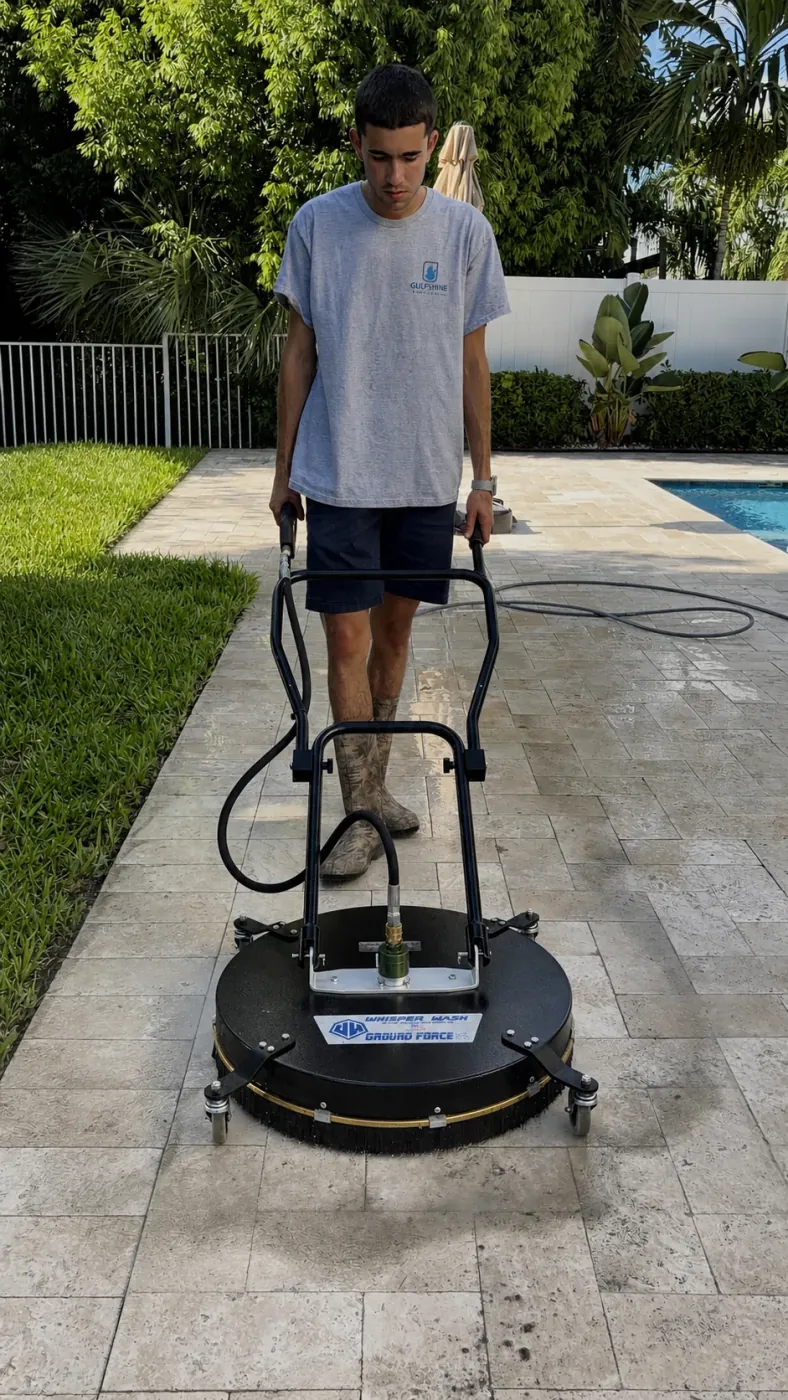
Behind the gates of Palm Beach Gardens communities, appearance is not optional: association standards cover driveways, walls, and walkways, and a mildewed elevation eventually draws a letter. Much of the hardscape here is paver rather than plain concrete, which changes the technique entirely, since blasting pavers at full force blows out joint sand and scars the very surface the visit was meant to improve.
Paver country has its own rules
Golf-community driveways, pool surrounds, and lanai floors around PGA-style neighborhoods are overwhelmingly paver and travertine, and pavers reward technique over raw force: controlled pressure, even overlapping passes, and attention to joint sand afterward. Plain concrete sidewalks and curbs still take the 2,500–3,500 PSI that industry practice assigns bare concrete, while the newer stucco these communities are built from, along with painted trim and garage surrounds, stays strictly in soft-washing territory below 500 PSI. Lake-fed irrigation adds its signature too: mineral streaks at wall bases and curb lines that need chemistry rather than harder spraying.
Scoping inside the gates
A walkthrough here starts with logistics that older neighborhoods never think about: gate procedures, vendor rules, and whatever appearance clause prompted the call. Then it maps surfaces by material, drive, walks, pool deck, patio, wall faces, fountain surrounds on lakefront lots, and assigns each a method, so the estimate reads as a plan rather than a single number. When an association letter started the process, the scope is written to close out exactly what the letter cited.
Boards, managers, and the shared footage
Entry monuments, perimeter walls, community sidewalks, and clubhouse surrounds can be quoted as separate line items for boards and property managers, phased so residents keep dry routes. On cadence, the industry-typical every 6–12 months holds for most hardscape here, with shaded north-side walks running shorter.
The community-wide picture, glass included, is on the Palm Beach Gardens service-area page, the technique on the main pressure washing page, and comparable gated-community work continues north into Jupiter.
Across the South Florida market, pressure washing generally runs $0.15-$0.40 per square foot for driveways and hardscape, with most single-home visits landing between $150 and $400. What pressure washing costs covers what moves the number; every Palm Beach Gardens scope is priced to the property, not an average.
Local issues considered
- Paver drives and walkways
- Mildew on newer stucco
- HOA appearance notices
How the scope is built
- Protect paver joints and faces
- Soft wash stucco and painted trim
- Quote common areas for associations
Property types
- Gated community homes
- Golf-course lots
- HOA common areas
Related questions
- Is pressure washing safe for pavers? ; It can be when pressure, distance, equipment, joint condition, and existing sealer are suited to the surface.
- Do you work with HOAs and property managers? ; Gulfshine serves shared-property and management audiences with clearly defined scopes and access planning.
- How much does pressure washing cost? ; South Florida market ranges by surface, what drives quotes up or down, and how to compare bids on scope rather than price alone.
Pressure Washing nearby
- Pressure Washing in North Palm Beach
- Pressure Washing in Jupiter
- Pressure Washing in Lake Park
- Pressure Washing in Juno Beach
Also in Palm Beach Gardens: Window Cleaning in Palm Beach Gardens. Or return to Pressure Washing or the Palm Beach Gardens service-area hub.
Last updated .